
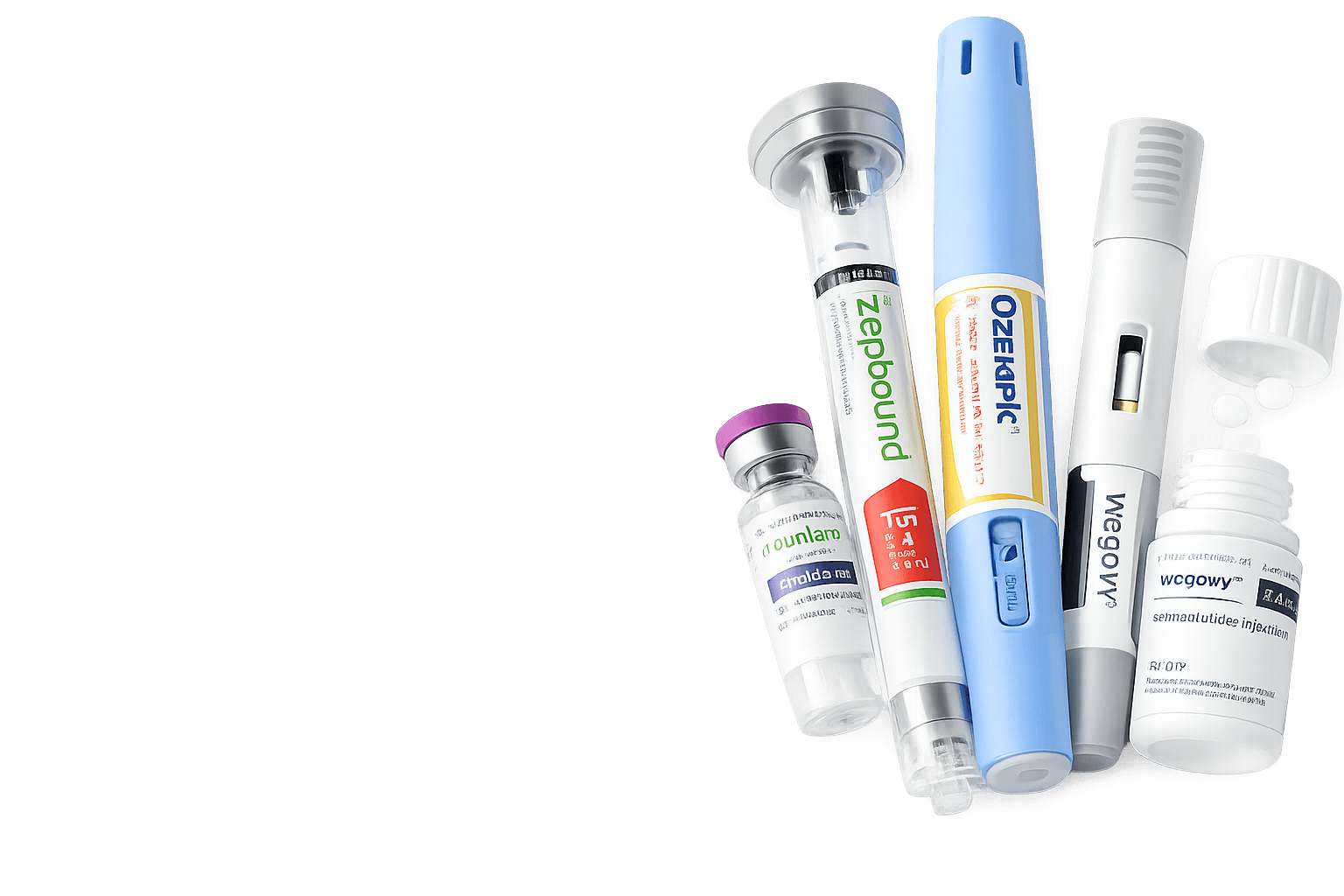

The quick answerInjections still produce the largest average weight loss: tirzepatide (Zepbound) reached 20.9% at the top dose in SURMOUNT-1 and semaglutide (Wegovy) 14.9% in STEP 1. The two FDA-approved pills are close behind on semaglutide's side of that gap: the Wegovy pill produced 13.6% in OASIS 4, which its authors describe as similar to the weekly injection, and Foundayo 11.2% in ATTAIN-1. Pills win on routine - no needle, and Foundayo has no food or water rules - but at cash prices the brand pills ($149-$349 a month) and brand pens ($1,149 and up) both sit far above compounded injections ($41-$299). With commercial coverage either pill can be $25 a month, and on Medicare's pilot both are $50.Trial figures are the published treatment-policy results linked below. Compounded and Ro prices verified on each provider’s site (November 3, 2026 for the price index, August 2026 for Ro’s brand products); manufacturer prices are as reported by dated sources and not verified by us.
What counts as a GLP-1 pill, and what counts as an injection
"Pills versus injections" sounds like one comparison. It is really four products in two categories, and the one you are offered online may be none of them, so the first job is to name them.
The injections: Wegovy and Zepbound
Wegovy is semaglutide, approved by the FDA for chronic weight management on June 4, 2021. Zepbound is tirzepatide, approved on November 8, 2023. Both are once-weekly injections under the skin from a pre-filled pen, started at a low dose and stepped up over months. Semaglutide acts on the GLP-1 receptor; tirzepatide acts on two receptors, GLP-1 and GIP, which is the usual explanation for its larger trial result. The same two molecules are also sold as compounded injections by state-licensed pharmacies through telehealth providers, at a fraction of the brand price and without FDA approval of the product. That is the route most of the providers on this site use, and most of the "injection" prices quoted online refer to it.
The pills: the Wegovy pill and Foundayo
The Wegovy pill is semaglutide in a 25 mg once-daily tablet, approved in December 2025 as the first oral GLP-1 for chronic weight management. Foundayo is orforglipron, a small-molecule GLP-1 receptor agonist from Eli Lilly, approved on April 1, 2026. Both are brand-name, prescription-only and FDA-approved; neither is compounded. A third tablet, Rybelsus, is lower-dose oral semaglutide approved for type 2 diabetes, not for weight management, and produces less weight loss at its diabetes doses.
And a category that is neither
Some telehealth programs sell compounded oral semaglutide or tirzepatide as tablets, sublingual drops or troches. These are not the Wegovy pill. They are compounded preparations with no trial data of their own, and a peptide taken by mouth is poorly absorbed without the formulation work the approved tablet went through. They belong in this guide only as a warning: if a program's "pill" is compounded, you are buying an unstudied product, not a cheaper Wegovy pill. The rest of this page compares the four approved products, plus the compounded injections, because those are the things with evidence and published prices behind them.
Results: what the trials actually showed
Every serious claim about these drugs traces back to four randomized, placebo-controlled trials, each run by the manufacturer on top of lifestyle advice. They were separate trials with different lengths and populations. Nobody has run a pill against an injection head to head, so the honest comparison is "each against its own placebo", not "pill versus shot".
| Product | Trial | Length | Mean weight change | Placebo |
|---|---|---|---|---|
| Zepbound (tirzepatide 15 mg weekly injection) | SURMOUNT-1, NEJM, July 21, 2022 | 72 weeks | -20.9% | -3.1% |
| Zepbound (tirzepatide 5 mg weekly injection) | SURMOUNT-1 | 72 weeks | -15.0% | -3.1% |
| Wegovy (semaglutide 2.4 mg weekly injection) | STEP 1, NEJM, March 18, 2021 | 68 weeks | -14.9% | -2.4% |
| Wegovy pill (oral semaglutide 25 mg daily) | OASIS 4, NEJM, September 2025 | 64 weeks | -13.6% | -2.2% |
| Foundayo (orforglipron 17.2 mg daily, the top approved strength) | ATTAIN-1, NEJM, September 2025; figure as presented in the FDA label (rev. 7/2026) | 72 weeks | -11.1% | -2.1% |
Two sets of numbers circulate for each of these trials, and both are real. The figures above count everyone who was randomized, whether or not they stayed on the drug (the treatment-policy or treatment-regimen analysis). Each manufacturer also publishes an on-treatment figure describing people who took the drug as directed to the end: 22.5% for tirzepatide at 15 mg, 16.6% for the Wegovy pill and 12.4% for Foundayo. Marketing tends to quote the second set; this guide uses the first, because it is closer to what a population of real patients experiences. They are not contradictory, just answers to different questions.
How to read the gap
Three conclusions survive the caveats. First, tirzepatide injection is still the strongest average performer of any GLP-1, pill or pen, by about six percentage points over semaglutide at the top dose, and in SURMOUNT-1 a substantially larger share of participants lost 20% or more. Second, the Wegovy pill and the Wegovy injection are close: 13.6% against 14.9% in their own trials, and the OASIS 4 authors describe the pill's effect as similar to the weekly injection. Third, Foundayo trails on the published number but still produced more weight loss than any non-GLP-1 pill ever approved; in ATTAIN-1, 19% of participants on the top dose lost 20% or more of their body weight, against 3% on placebo.
What the numbers do not say is also worth stating. They are averages measured at the full maintenance dose after a long titration, so they describe month fifteen, not month two. In STEP 1, about a third of participants lost 20% or more and some lost very little, and nothing on an intake form predicts which group you will be in. And every trial included lifestyle counselling that most telehealth programs do not provide. Treat the trial figures as a ceiling that a well-run, fully-dosed course can approach, not a promise for either format.
Our top 2 picks
Our two recommended GLP-1 providers, shown with the same verified pricing and ratings as our full comparison.
Our Top Pick
1
Exceptional
9.8out of 10
Compounded GLP-1 from $49/month; not FDA-approved, free expedited delivery
Free expedited deliveryNo hidden fees
Treatments offered
Compounded semaglutide injections (GLP-1), not FDA-approved · Compounded tirzepatide injections (dual GIP/GLP-1), not FDA-approved · Online intake and prescriber review by OpenLoop Health clinicians · Transfer at your current dose with proof of your existing prescription
Starting price
$49/month
*Compounded medications are not FDA-approved.
- Compounded semaglutide ($49/mo) and tirzepatide ($99/mo) as shown on the homepage, Nov 16, 2026; not FDA-approved
- Online intake, then a prescriber review by OpenLoop Health, a network of US-licensed doctors
- Free expedited delivery (embody's words); the Terms do not guarantee a delivery timeline
- No insurance required, no clinic visits; cancel at least 72 hours before the next billing date
Pricing starts at
from $49/month
Doctor-prescribed compounded GLP-1 treatment, not FDA-approved: semaglutide shown at $49/month and tirzepatide at $99/month on embody's homepage (Nov 16, 2026), no insurance required.
Read full embody review2
Exceptional
9.7out of 10
Compounded GLP-1 at one flat price - $99 semaglutide, $129 tirzepatide, every month
Same price, every doseNo membership or long-term plans
Treatments offered
Compounded semaglutide (GLP-1) injection · Compounded tirzepatide (GLP-1 + GIP) injection · Doctor-guided dosing with ongoing clinical care · 24/7 human support
Starting price
$99/month
*Compounded medications are not FDA-approved.
- Compounded semaglutide $99/month - same price at every dose
- Compounded tirzepatide $129/month - same price at every dose
- One all-inclusive price: no membership, no annual or long-term plans
- Doctor-guided clinical care with 24/7 human support
Pricing starts at
from $99/month
Compounded GLP-1 program at one flat monthly price - semaglutide $99/month and tirzepatide $129/month, the same at every dose, with no annual or long-term plan required and doctor-guided care with 24/7 human support.
Read full Eden reviewWhy a pill needs a bigger dose than a pen
The Wegovy injection delivers 2.4 mg of semaglutide once a week. The Wegovy pill contains 25 mg, taken every day, for a drug that produces a similar result. The difference is absorption. Semaglutide is a peptide, and peptides are broken down in the gut; only a small fraction of a swallowed dose reaches the bloodstream, so the tablet carries far more and has to be taken under conditions that protect what little is absorbed. That is the reason for the empty-stomach rule described in the next section, and it is why compounded "oral semaglutide" without that formulation work is a different and unstudied thing.
Foundayo takes the other path. Orforglipron is not a peptide but a small molecule designed to be absorbed through the gut the way most ordinary tablets are, which is why it can be taken at any time of day with or without food. Its trade-off, on the published numbers, is a smaller average weight loss than semaglutide in either form. The injections sidestep absorption entirely: the drug goes under the skin and into circulation, which is why a weekly dose measured in milligrams works.
The routine: empty stomach, any time, or once a week
For most people this is the difference they will feel every day, and it is where the "pills are more convenient" assumption needs unpacking.
| Product | How often | The rules |
|---|---|---|
| Wegovy pill | Once a day | On an empty stomach, with a small sip of water, then a 30-minute wait before food, drink or other medicines. Dose stepped up from 1.5 mg to 25 mg over the first months. |
| Foundayo | Once a day | Any time of day, with or without food or water. Six tablet strengths from 0.8 mg to 17.2 mg, stepped up at least 30 days apart. |
| Wegovy or Zepbound pen | Once a week | A self-injection under the skin from a pre-filled, factory-sealed pen. No daily routine; dose stepped up every few weeks. |
| Compounded injection | Once a week | Drawn from a multi-dose vial into a syringe. You measure the dose in units yourself, which is where the FDA has recorded dosing errors. |
The Wegovy pill is the most demanding routine on the table. A 30-minute wait every morning before coffee, breakfast or other medication is manageable for many people and a deal-breaker for some; miss the timing and absorption drops, so the rule is not optional. Foundayo is the simplest. No timing, no food rule, no needle: for someone who takes morning medication or does not want a timed routine, that is its main argument. The weekly pen is a different kind of simple. Fifty-two small, sealed, pre-measured doses a year and nothing to think about in between; the needle is fine and short, and most people who were anxious about it report that the first injection settles the question. The compounded vial is the least convenient and the most error-prone, because the patient measures the dose. The FDA's statement on unapproved GLP-1 drugs records adverse-event reports that trace to dosing mistakes with vials, and our guide to reading a compounded prescription explains the units.
Cost: every verified price, by route
Format decides far less than route. Two facts organise the whole table: the brand products, pill or pen, cost brand prices for cash, and the compounded injections cost a fraction of that because the product is not FDA-approved. Everything below is either a provider's own published price as we verified it (the compounded and Ro figures, checked on each provider's site on November 3, 2026 for the price index and in August 2026 for Ro's brand products) or a manufacturer price as reported by the dated source linked, which we have not verified ourselves.
| Route | Monthly price | The condition |
|---|---|---|
| Compounded semaglutide injection (verified) | $41-$199 | $41 at welludr on a 12-month plan; $49 month to month at embody; $89 flat at every dose at altRx; $99 promotional, all-inclusive, at Medvi |
| Compounded tirzepatide injection (verified) | $71-$299 | $71 at welludr on a 12-month plan; $99 month to month at embody; $149 flat at altRx; $166 promotional at Medvi |
| Wegovy pill at Ro (verified) | $149 first month, then $299 | Plus Ro's membership: $39 the first month, then $74-$149 a month. The pill is billed separately, so insurance can apply where your plan covers Wegovy |
| Wegovy pill, NovoCare direct self-pay (reported) | $149-$299 by dose | Per third-party trackers: $149 at the starting dose rising to $299 at the 25 mg maintenance dose. Not verified by us |
| Foundayo, LillyDirect self-pay (reported) | $149-$349 by dose | As reported by Scientific American from Lilly material. No telehealth provider we track has published a Foundayo price we could verify |
| Either pill with commercial insurance that covers it (reported) | $25 | Lilly's savings card per its April 9, 2026 release; Novo Nordisk's offer reported at as low as $25, capped at $100 of savings per 30-day supply. Not available on government plans |
| Medicare GLP-1 Bridge: both pills, both pens | $50 flat copay | CMS pilot, July 1, 2026 through December 31, 2027; eligibility and approval through your Part D plan. The $50 does not rise with the dose |
| Brand Zepbound pen, cash (verified) | $1,249-$1,599 | $1,249 at altRx, $1,599 at welludr; Ro sells Zepbound KwikPens from $299 the first month, then $399-$449, plus membership |
| Brand Wegovy pen at Ro (verified) | from $199 introductory, then $299-$399 | Plus the same membership; billed separately so insurance can apply |
The year-one arithmetic
Month-one prices mislead in both directions. Put together at Ro's cash prices, a first year on the Wegovy pill comes to roughly $4,300-$5,100: $3,438 of medication plus $853-$1,678 of membership depending on the tier. A year of compounded semaglutide runs from $492 on welludr's 12-month plan to roughly $1,800-$2,400 at month-to-month providers, and compounded tirzepatide about $500-$1,200 more. A year of brand Zepbound for cash is five figures. The only routes that undercut compounded are the $25 commercial savings cards and Medicare's $50 pilot, which is why coverage is the first question, not the format. Our month 1 vs year one guide does this arithmetic for every provider we track, and Wegovy pill price online walks the semaglutide pill's routes in full.
Side effects: same class, same profile
A pill is not a gentler GLP-1. All four products act on the same receptor family and share the same side-effect profile: mostly gastrointestinal, mostly in the first weeks, mostly around dose increases. In OASIS 4, gastrointestinal adverse events occurred in 74% of people on the Wegovy pill against 42% on placebo, led by nausea and diarrhoea. In ATTAIN-1, gastrointestinal events were also the most frequent with Foundayo and were typically mild to moderate. The injection labels, summarised on MedlinePlus for semaglutide and tirzepatide, list the same leading effects: nausea, diarrhoea, vomiting, constipation, abdominal pain and reduced appetite.
The serious warnings are shared too. Every product here carries the class boxed warning about thyroid C-cell tumours observed in rodents and is contraindicated for people with a personal or family history of medullary thyroid carcinoma or Multiple Endocrine Neoplasia syndrome type 2; the labels also warn about pancreatitis and gallbladder disease. Tirzepatide's label adds that it can reduce the effectiveness of oral contraceptives for four weeks after starting and after each dose increase. Neither pill trial reported a safety signal outside the known class profile.
What actually changes tolerability is the titration: how low you start and how slowly you step up. A clinician who manages that, and who slows the schedule when side effects persist, matters more than whether the drug is a tablet or a pen. Our semaglutide side-effects guide covers what helps in the first weeks on either format.
Insurance and Medicare: where the pills pull ahead
This is the one area where the format genuinely changes the answer, because the brand pills launched inside programmes the compounded injections can never join.
Commercial insurance. If your plan covers the drug for weight management, each manufacturer offers a savings card: Lilly's brings Foundayo to $25 a month, and Novo Nordisk's is reported to bring the Wegovy pill to as low as $25, capped at $100 of savings per 30-day supply. Neither card works on Medicare, Medicaid or other government plans. Coverage itself is the gate; many plans still exclude weight-management GLP-1s or require prior authorisation, and our insurance guide explains how to check your formulary before choosing. Where a plan covers the brand injection instead, the same logic applies to Wegovy and Zepbound pens, and a telehealth prescriber such as Ro can run the prior authorisation and bill the medication as its own line item.
Medicare. Since July 1, 2026, the Medicare GLP-1 Bridge pilot charges eligible beneficiaries a flat $50 copay a month for the Wegovy pill and injection, the Zepbound KwikPen and Foundayo, through December 31, 2027. The $50 does not rise with the dose, and it applies to both formats equally, so a Medicare patient chooses on routine and results, not price. Medicare never covers compounded GLP-1s. GLP-1s after 65 covers what to ask your Part D plan.
Paying cash. Then the compounded injections are the cheapest route by thousands of dollars a year, the brand pills are the cheapest FDA-approved route, and the brand pens are the most expensive option on the page.
Compounded versions: legal under conditions, not FDA-approved
Because most of the "injection" prices in this guide are compounded prices, it is worth being precise about what that means. Compounding is a licensed pharmacist preparing a medication for an individual patient under a prescription, allowed under two federal frameworks described on the FDA's human drug compounding page: section 503A, state-licensed pharmacies compounding for a specific patient, which is the route almost every telehealth GLP-1 program uses; and section 503B, registered outsourcing facilities producing larger batches under tighter oversight.
Compounded GLP-1s grew when semaglutide and tirzepatide were on the FDA's shortage list, which allows compounding with fewer restrictions. That window closed: the FDA declared the tirzepatide shortage resolved on December 19, 2024 and the semaglutide shortage on February 21, 2025. What remains legal is a patient-specific prescription where the prescriber documents a clinical need the approved product does not meet. The FDA's own summary of its concerns is the thing to read before buying: compounded products are not reviewed for safety, effectiveness or quality before sale; the agency has received adverse-event reports including dosing errors from vials; some products have been found to contain salt forms of semaglutide that are not the approved active ingredient; and products sold without a prescription may be counterfeit.
None of that makes compounded injections a scam. It means the quality lives in the pharmacy rather than in a brand, and that you are trusting the telehealth provider's choice of pharmacy. The providers on this site name theirs, and that is the first thing we check. Note that there is no compounded equivalent of Foundayo at all, and no compounded oral product that has the Wegovy pill's evidence behind it: if you want a pill, the two approved pills are the pills. Our compounded vs brand-name guide and the 503A vs 503B explainer go deeper.
Switching, stopping and the long term
People move between formats more often than the marketing suggests: a pill to an injection after plateauing, an injection to a pill when insurance changes, a brand pen to a compounded vial when a savings card expires. All of it goes through the prescriber. There is no do-it-yourself conversion between a weekly 2.4 mg pen and a daily 25 mg tablet, or between semaglutide and orforglipron, and a clinician will usually restart a titration rather than jump to the equivalent dose.
Whichever format you choose, it is a maintenance medication in the way blood-pressure medication is. In the STEP 1 extension, participants who stopped semaglutide and the lifestyle program regained about two-thirds of the weight they had lost within a year (Wilding et al., Diabetes, Obesity and Metabolism, April 19, 2022). That is the number to budget around, and it is the strongest argument for choosing the route whose year-two price you can sustain rather than the one with the cheapest first month. Our guide to what happens when you stop covers the tapering and maintenance strategies clinicians use.
Which should you choose? Five readers, five answers
There is no universal right answer, but most people fit one of these.
Your insurance covers a GLP-1 for weight management. Take the covered product. At $25 a month either pill, or a covered pen, beats every cash route on this page, and the gap between the pills is a rounding error at that price. Check the formulary first; it decides more than anything else here.
You are on Medicare. Ask your Part D plan about the GLP-1 Bridge before pricing anything. At a flat $50 for all four brand products, choose on routine and results: the injection for the larger trial result, Foundayo for the simplest routine.
You are paying cash and the result is what matters most. The published evidence points to tirzepatide, and the compounded injection is the only affordable way to it: $89 a month on a 12-month plan, $99 with no commitment on embody's pre-Black Friday sale. Read best tirzepatide online for every verified price, and go in understanding that it is not an FDA-approved product.
You are paying cash and you will not inject. The Wegovy pill through Ro is the one verified telehealth route to an approved pill today, at $149 then $299 plus membership; Foundayo's reference price is LillyDirect's reported $149-$349. Between the two, the Wegovy pill has the larger trial result and Foundayo has no timing rules; Foundayo vs the Wegovy pill compares them line by line. Do not accept a compounded "pill" as a substitute.
You are paying cash and price decides. Compounded semaglutide injection from $41-$99 a month is the floor of the whole market, and the needle is a weekly thirty seconds that most people stop noticing by the second month. What $100-$200 a month gets you lays out what each price band buys.
Whatever you pick, a licensed clinician decides on your history, not on a table, and can decline to prescribe any of them.
How to get either one online
The process is the same for a pill or an injection, and it is the only legal process: an online intake covering your weight, health history, medications and goals; a review by a licensed clinician, by questionnaire, message or video; a prescription if appropriate, filled either by the provider's partner pharmacy and shipped to you, or sent to a pharmacy of your choice where insurance applies; and follow-up as the dose steps up. For the brand pill, Ro is the provider we have verified. For compounded injections, the providers ranked on our weight-loss comparison all run that review before prescribing, and the complete guide to GLP-1 weight loss online walks every step from intake to first dose, including what to check about the pharmacy, the refund terms if you are not approved, and the questions to ask before prepaying.
This guide is general information, not medical advice. GLP-1 medications require evaluation and supervision by a licensed healthcare provider, who decides whether any of them is appropriate for you.