
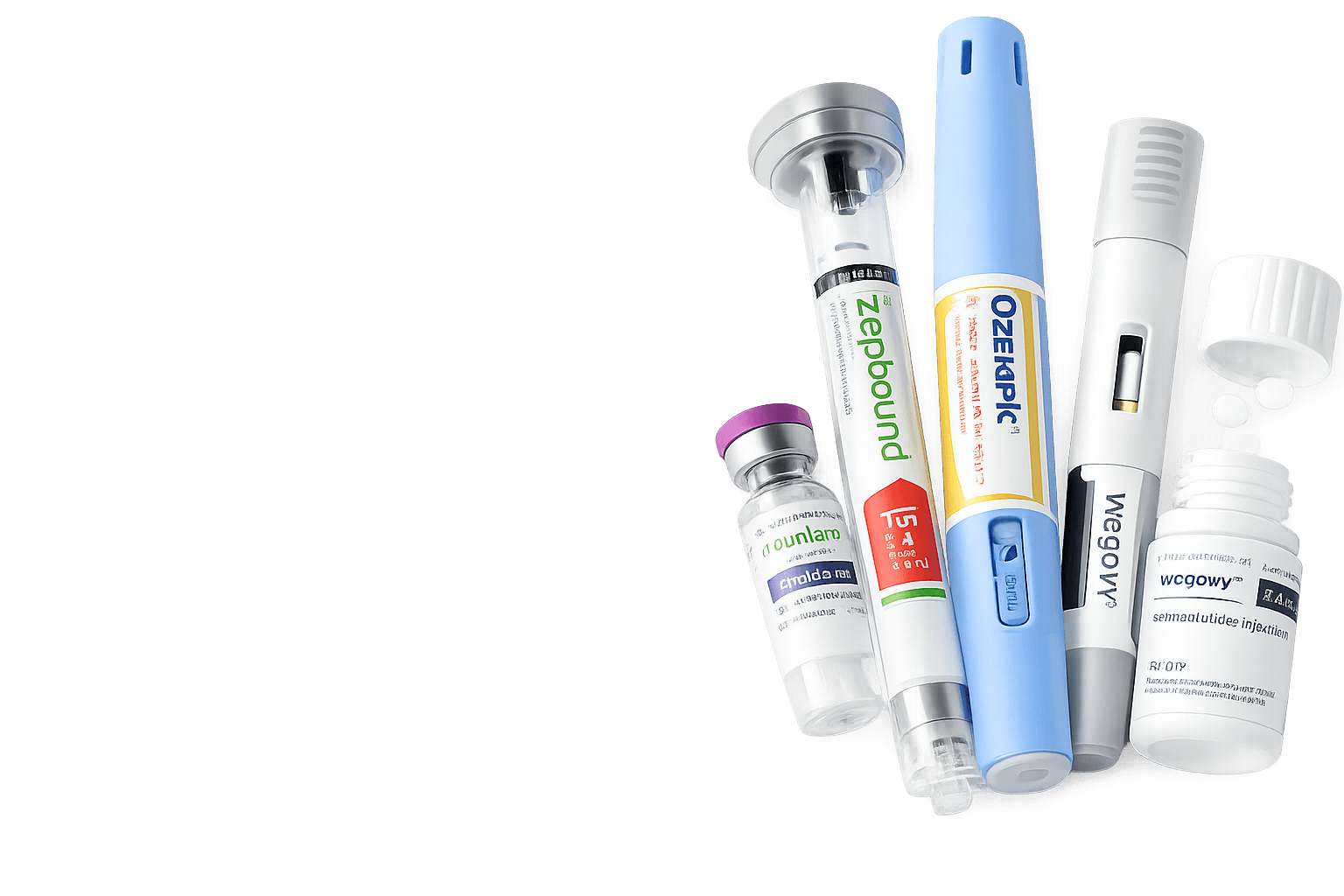

The quick answerYou can get a GLP-1 online three ways, each needing a licensed clinician's prescription: brand-name Wegovy or Zepbound (pens or the new pills) through a telehealth prescriber or your insurance, or compounded semaglutide or tirzepatide from a state-licensed pharmacy through a telehealth provider. Verified compounded prices run $49-$199/month for semaglutide and $89-$299/month for tirzepatide; brand-name cash starts around $1,249/month. The pivotal trials showed about 15% mean weight loss on semaglutide and up to 21% on tirzepatide after 15-17 months, with most of it regained within a year of stopping.Prices verified on each provider’s site as of October 16, 2026.
What 'GLP-1 weight loss online' actually means in 2026
Five years ago, getting a GLP-1 medication for weight loss meant an endocrinologist, an insurance fight and a pharmacy that might or might not have it in stock. In 2026 the same prescription can be written after an online intake, filled by a mail-order pharmacy and delivered in a cold pack to your door, at a cash price that in some cases is lower than a copay. That convenience created an industry - and a lot of confusion about what, exactly, you are buying.
This guide is the long version. It is written for someone who has decided they want to find out whether a GLP-1 is right for them and wants to understand the whole path before spending money: how the drugs work, which molecule to consider, what is legal, who qualifies, what it costs at every provider we have verified, how the process runs from intake to first injection, how to pick a provider, what the first twelve weeks feel like, what results the trials actually showed, and where the traps are. Each section stands alone, so skip to what you need; the shorter guides linked throughout go deeper on single questions.
The three routes, in one paragraph each
Route one: brand-name through a telehealth prescriber. Wegovy (semaglutide) and Zepbound (tirzepatide) are the FDA-approved injectable pens for chronic weight management. The Wegovy pill (oral semaglutide 25 mg) and Foundayo (orforglipron) joined them as approved daily tablets. A telehealth provider such as ro can prescribe them, bill your insurance where it applies, or sell them cash. This is the only route where the product itself has been through FDA review.
Route two: compounded semaglutide or tirzepatide through a telehealth provider. A state-licensed compounding pharmacy prepares the same active ingredient under a clinician's patient-specific prescription. It is not an FDA-approved product, which is the trade-off behind prices that start at $49 a month instead of four figures. Most of the providers on this site - embody, welludr, altRx, Eden, Medvi, TrimRx, DirectMeds and others - work this way.
Route three: brand-name through your own insurance. If your plan covers Wegovy or Zepbound for weight loss, a telehealth prescriber can run the prior authorization and send the prescription to a retail or mail pharmacy like any other. Coverage applies to the medication, not to how you saw the clinician. Our insurance guide covers what plans typically require.
What all three have in common: a licensed clinician reviews your health history and decides whether to prescribe. There is no legal route to a GLP-1 without that step, and any website offering one without it is selling something you should not inject.
How to read the prices in this guide
Every provider price quoted here was checked on the provider's own site on October 16, 2026 and is carried with the condition that goes with it - a 12-month plan, a first-month promotion, a flat rate at every dose. Prices change; the providers' pages are the only live source, and our price-change log records every change we have caught since we started tracking. Manufacturer and third-party figures are cited with their date and are not verified by us. Where we could not verify something, we say so rather than estimate.
Our top 2 picks
Our two recommended GLP-1 providers, shown with the same verified pricing and ratings as our full comparison.
Our Most Popular
1
Exceptional
9.8out of 10
Limited Offer - GLP-1 for $69/mon
Money-back guaranteeFree expedited delivery
Treatments offered
Compounded semaglutide injections (GLP-1) · Compounded tirzepatide injections (GLP-1 + GIP) · 100% online doctor review and prescription · Dosage adjustments through the patient portal
Starting price
$79$69/month
*Compounded medications are not FDA-approved.
- Compounded semaglutide ($69/mo) and tirzepatide ($119/mo)
- 5-minute health qualifier; doctor review usually within 24 hrs
- Free 1-2 day shipping - temperature-controlled, tracked, insured
- No insurance required, no clinic visits, cancel anytime
Pricing starts at
from $69/month
Doctor-prescribed GLP-1 treatment - compounded semaglutide from $69/mo and tirzepatide from $119/mo - shipped in 1-2 days with no insurance required. Rated 3.8 across 9,604 Trustpilot reviews.
Read full embody review2
Exceptional
9.7out of 10
Most Comprehensive GLP-1 Medication Access
Transparent pricingNo insurance required
Treatments offered
Compounded semaglutide (GLP-1) injection · Compounded tirzepatide (GLP-1 + GIP) injection · Brand-name Zepbound and Wegovy · One simple injection per week
Starting price
$199$89/month
*Compounded medications are not FDA-approved.
- Compounded GLP-1 from $89/mo, GLP-1 + GIP from $149/mo
- Brand-name options too: Zepbound and Wegovy
- Clinician-guided - physician, PA, or nurse practitioner
- Free shipping (about 5-7 days)
Pricing starts at
from $89/month
Affordable GLP-1 program from $89/month - compounded semaglutide and tirzepatide plus brand-name options - with clinician-guided, self-pay care and no insurance required.
Read full altRx reviewHow GLP-1 medications work, and what the trials showed
GLP-1 stands for glucagon-like peptide-1, a hormone your gut releases within minutes of eating. It tells the pancreas to release insulin, slows the rate at which your stomach empties, and signals the brain that food has arrived. Natural GLP-1 breaks down within a couple of minutes. The medications are engineered versions of the hormone that resist that breakdown, so a once-weekly injection keeps the "you have eaten" signal switched on for days. The result most people notice first is not willpower but the absence of the usual hunger: smaller portions feel like enough, and the mental noise around food goes quiet. The physiology is covered in plain language in our guide to how GLP-1 medications work.
Semaglutide and tirzepatide are not the same drug
Semaglutide acts on the GLP-1 receptor only. Tirzepatide acts on two receptors - GLP-1 and GIP (glucose-dependent insulinotropic polypeptide) - which is why it is sometimes described as a "dual agonist" and why, in its trials, it produced larger average weight loss. Both are given as a once-weekly injection under the skin, and both are started at a low dose and stepped up over months to limit stomach side effects.
The numbers from the pivotal trials
These are the two studies every serious claim about these drugs traces back to. Both were randomized, double-blind and placebo-controlled in adults with obesity (or overweight with a weight-related condition) without diabetes, on top of lifestyle advice.
| Trial | Drug and dose | Length | Mean weight change | Placebo |
|---|---|---|---|---|
| STEP 1 (NEJM, March 18, 2021) | Semaglutide 2.4 mg weekly | 68 weeks | -14.9% | -2.4% |
| SURMOUNT-1 (NEJM, July 21, 2022) | Tirzepatide 5 mg weekly | 72 weeks | -15.0% | -3.1% |
| SURMOUNT-1 | Tirzepatide 10 mg weekly | 72 weeks | -19.5% | -3.1% |
| SURMOUNT-1 | Tirzepatide 15 mg weekly | 72 weeks | -20.9% | -3.1% |
Sources: Wilding et al., Once-Weekly Semaglutide in Adults with Overweight or Obesity, New England Journal of Medicine, March 18, 2021; Jastreboff et al., Tirzepatide Once Weekly for the Treatment of Obesity, New England Journal of Medicine, July 21, 2022. The SURMOUNT-1 figures above are the treatment-regimen estimand; the paper's efficacy estimand, which assumes everyone stayed on treatment, reports up to 22.5% at 15 mg, the figure most marketing quotes.
Three things those numbers do not say. First, they are averages: in STEP 1 about a third of participants lost 20% or more and some lost very little, and nothing in an intake form predicts which group you will be in. Second, they were measured at the full maintenance dose after a long titration, so they describe month fifteen, not month two. Third, they include the lifestyle counseling everyone in the trial received, which is more than most telehealth programs provide. Treat the trial figures as a ceiling that a well-run, fully-dosed course can approach, not a promise for a $49 plan.
What happens when you stop
The least-advertised result is the one that should shape how you budget. In the STEP 1 extension, participants who stopped semaglutide and the lifestyle program regained about two-thirds of the weight they had lost within a year (Wilding et al., Diabetes, Obesity and Metabolism, published April 19, 2022). These are maintenance medications in the way blood-pressure medication is: they work while you take them. Our guide to what happens when you stop covers tapering and maintenance strategies clinicians use.
Why the pills matter now
Until late 2025 "GLP-1 for weight loss" meant an injection. The Wegovy pill - oral semaglutide at 25 mg - was FDA-approved in December 2025 as the first oral GLP-1 for chronic weight management, and Foundayo (orforglipron, Eli Lilly) followed on April 1, 2026. Both are brand-name, prescription-only and priced like brand-name products, but they remove the needle, which for many people was the reason not to start. The difference in routine is practical: the Wegovy pill is taken on an empty stomach with a sip of water and a 30-minute wait before eating, while Foundayo has no food or water restriction. Our Foundayo vs Wegovy pill comparison sets out the trial results and prices side by side, and GLP-1 pills vs injections explains why the compounded "pills" and "drops" sold by some programs are a different category entirely.
Semaglutide or tirzepatide: how to choose the molecule
The first fork in the road is the molecule, because it changes the price by roughly $40 to $100 a month at the same provider and changes what the evidence says you can expect. There is no universal right answer. Here is how the two compare on the things that decide it.
| Factor | Semaglutide | Tirzepatide |
|---|---|---|
| Brand names | Ozempic (diabetes), Wegovy (weight), Wegovy pill | Mounjaro (diabetes), Zepbound (weight) |
| Receptors | GLP-1 | GLP-1 and GIP |
| Pivotal-trial weight loss | -14.9% at 68 weeks (STEP 1) | -15.0% to -20.9% by dose at 72 weeks (SURMOUNT-1) |
| Verified compounded price range | $49-$199/month | $89-$299/month |
| Cheapest verified compounded price | $49/month, welludr, 12-month plan | $89/month, welludr, 12-month plan |
| Cheapest no-commitment price | $69/month, embody | $119/month, embody |
| Oral option | Wegovy pill (approved December 2025) | None; Foundayo is a different molecule |
| Years on the US market | Since 2017 (Ozempic), 2021 (Wegovy) | Since 2022 (Mounjaro), 2023 (Zepbound) |
When semaglutide is the sensible first choice
It is cheaper everywhere we track by a margin that adds up to $480 to $1,200 over a year. It has the longer safety record, with more years of real-world use. The trial result - about 15% mean weight loss - is a large number by any historical standard; for a 220-pound person it is 33 pounds. And it has an oral form if injections are the obstacle. For a first course where you do not yet know how your body responds, starting on the lower-cost molecule and switching only if you plateau is the sequence most clinicians describe.
When tirzepatide earns its price
The trial gap is real: at the top dose, tirzepatide's average loss was about six percentage points greater than semaglutide's in its own trial, and the proportion of participants reaching 20% or more was substantially higher. If your goal is large (say, 60 pounds or more), if you have already been on semaglutide and stalled, or if a clinician judges that the dual mechanism suits your metabolic picture, the extra cost buys a measurably larger expected result. Our tirzepatide vs semaglutide guide walks through the head-to-head evidence, and best tirzepatide online lists every verified tirzepatide price.
Side effects are similar, not identical
Both labels list the same leading adverse events - nausea, diarrhea, vomiting, constipation, abdominal pain, reduced appetite - clustered around dose increases. Both carry the same boxed warning about thyroid C-cell tumors observed in rodents, and both are contraindicated for people with a personal or family history of medullary thyroid carcinoma or Multiple Endocrine Neoplasia syndrome type 2. Tirzepatide's label adds a specific note that it can reduce the effectiveness of oral contraceptives for four weeks after starting and after each dose increase. There is no reliable way to predict which molecule you will tolerate better; if one causes persistent side effects a clinician may slow the titration or switch you. The labels are summarized on MedlinePlus for semaglutide and tirzepatide.
The honest answer to "which is better"
Tirzepatide produced more weight loss in trials. Semaglutide costs less, has been used longer and comes as a pill. Which is "better" depends on the size of your goal, your budget over a year rather than a month, and how you respond - which nobody can know in advance. What we can say with confidence is that either, taken as prescribed at a maintenance dose for a year, has produced results in controlled trials that no previous weight-loss medication came close to.
Brand-name, compounded, or pills: what is legal and what you are actually buying
This is the section to read twice, because it is where most of the money and most of the risk sits. "GLP-1 online" covers four different products that are sold with similar language and very different legal standing.
Brand-name pens and pills: FDA-approved, priced accordingly
Wegovy was approved for chronic weight management on June 4, 2021 (FDA press announcement) and Zepbound on November 8, 2023 (FDA press announcement). Each dose is a factory-made, sealed pen whose contents were tested in the trials above and whose manufacturing is inspected by the FDA. The Wegovy pill and Foundayo carry the same status. The cash prices online reflect that: on the providers we have verified, brand-name Zepbound is $1,249 a month at altRx and $1,599 at welludr; Ozempic is $1,399 at welludr; ro sells Zepbound KwikPens from $299 the first month then $399-$449, and the Wegovy pill at $149 the first month then $299, in each case plus its membership. Our Zepbound price guide and Wegovy pill price guide keep these current and explain the manufacturers' own direct-pay programs, whose prices we report from dated third-party sources but have not verified ourselves.
Compounded semaglutide and tirzepatide: legal under conditions, not FDA-approved
Compounding is the practice of a licensed pharmacist preparing a medication for an individual patient under a prescription. US federal law allows it under two frameworks, both described on the FDA's human drug compounding page. Section 503A covers state-licensed pharmacies compounding for a specific patient on a specific prescription; this is the route almost every telehealth GLP-1 program uses, which is why "503A pharmacy" appears so often on provider sites. Section 503B covers registered outsourcing facilities that can produce larger batches under tighter federal oversight.
The reason compounded GLP-1s exploded in 2023 and 2024 is that both semaglutide and tirzepatide were on the FDA's drug shortage list, and the law allows compounding of a drug in shortage with fewer restrictions. That window has closed. The FDA declared the tirzepatide shortage resolved on December 19, 2024, and the semaglutide shortage resolved on February 21, 2025, with enforcement grace periods that ended in the spring of 2025 (FDA statement on compounder policies). What remains legal is what was always legal: a 503A pharmacy may compound for an individual patient when a prescriber documents a clinical need that the approved product does not meet - a different dose, a different formulation, an added ingredient, an inability to tolerate an excipient. Mass-producing copies of the approved drug is not permitted. Enforcement is ongoing and the rules continue to evolve; the practical consequence for you is that the prescription should be patient-specific and the pharmacy should be named.
The FDA's own summary of the risks is worth reading in full: FDA's Concerns with Unapproved GLP-1 Drugs Used for Weight Loss. The agency's points, in short: compounded products are not reviewed for safety, effectiveness or quality before they are sold; it has received reports of adverse events including dosing errors from vials that require the patient to measure a dose; some products have been found to contain salt forms of semaglutide (semaglutide sodium, semaglutide acetate) that are not the active ingredient in the approved drugs; and products sold without a prescription or from unlicensed sources may be counterfeit.
None of that means compounded GLP-1 is a scam. It means the quality lives in the pharmacy, not in a brand, and that you are trusting the telehealth provider's choice of pharmacy. The providers on this site name theirs, and that is the first thing we check. Our guide to compounded vs brand-name semaglutide and the 503A vs 503B explainer go deeper, including the "28-day rule" on beyond-use dating that determines how much medication a pharmacy can ship at once.
Compounded "pills," "drops" and "gum": a different thing again
Some programs sell compounded oral semaglutide as tablets, sublingual drops or troches. These are not the FDA-approved Wegovy pill, which is a specific formulation designed to survive the stomach; they are compounded preparations with no trial data of their own, and oral absorption of a peptide is poor without the formulation work the approved pill went through. If you want a pill, the two approved options exist. If a program's "pill" is compounded, understand that you are buying an unstudied product, not a cheaper Wegovy pill. Our weight-loss pills guide separates the categories.
The one-sentence test
If a product is described as "FDA-approved" and it is compounded, the description is false - the FDA said so in a June 2026 warning letter to altRx's parent company over marketing that suggested approval, as we note in our altRx review. If a product requires no prescription, it is not a legal GLP-1 in the United States. Everything else is a question of price, pharmacy and terms, which the rest of this guide is about.
What To Know Before Starting GLP-1 Treatment
Before starting GLP-1 treatment, it's important to understand a few key things. These medications require a prescription from a licensed clinician and aren't suitable for everyone. Some people may experience side effects, especially during the first few weeks as the body adjusts.
GLP-1s also tend to work best when combined with basic lifestyle habits like balanced nutrition and regular physical activity.
That's why choosing a provider that offers proper medical screening and ongoing follow-up support is essential for both safety and long-term success.

Do you qualify? Eligibility, disqualifiers and what the intake asks
The online intake is not a formality. A licensed clinician - a physician, nurse practitioner or physician assistant, depending on the provider and your state - reviews it and can decline. Knowing the criteria in advance saves you a declined application and, at providers without a refund-if-declined policy, the fee.
The label criteria
Wegovy and Zepbound are indicated for adults with a body mass index of 30 or more, or 27 or more with at least one weight-related condition such as type 2 diabetes, high blood pressure, high cholesterol or obstructive sleep apnea. Telehealth providers prescribing compounded versions generally apply the same thresholds. BMI is weight in kilograms divided by height in meters squared; at 5'6" the 27 threshold is about 167 pounds and the 30 threshold about 186 pounds. Our guide to who qualifies has a full table by height.
Disqualifiers every provider screens for
- A personal or family history of medullary thyroid carcinoma, or Multiple Endocrine Neoplasia syndrome type 2 (the boxed warning on both labels).
- A history of pancreatitis.
- Severe gastrointestinal disease, including gastroparesis, since the drugs slow stomach emptying.
- Pregnancy, planning a pregnancy, or breastfeeding. The labels advise stopping at least two months before a planned pregnancy.
- Type 1 diabetes, and insulin or sulfonylurea use without diabetes supervision, because of hypoglycemia risk.
- Current or recent eating disorder, at most providers.
- Age under 18 for the compounded programs (Wegovy itself is approved from age 12 under specialist care).
Interactions and conditions to declare
Because GLP-1s slow stomach emptying, they can change how quickly oral medications are absorbed; the clinician needs your full medication list, including thyroid hormone, anticoagulants and oral contraceptives (the tirzepatide label specifically advises a backup method for four weeks after starting and after each increase). Kidney disease, diabetic retinopathy, gallbladder disease and a history of depression or suicidal thoughts are not automatic disqualifiers but will be asked about and may change the recommendation. Honesty here protects you: the same answers that might get you declined are the ones that would make the medication dangerous.
What the intake looks like in practice
Expect 10 to 25 minutes of questions: height, weight and sometimes a photo for BMI verification; medical history; medications; weight-loss history; goals; and at some providers a short video or phone consultation. Many providers ask for recent lab work and will order it if you have none; some accept an attestation. A government ID is required, because the prescription is written in your name. Then the clinician reviews - typically within one to three days, at embody usually within 24 hours - and either prescribes, asks follow-up questions, or declines. If you do not qualify for a GLP-1, several providers offer alternatives such as metformin or bupropion-naltrexone; our alternatives guide covers them.
If you are declined
Check the refund terms before you apply, not after. embody refunds in full if a clinician does not approve you. Others vary, and some charge a consultation fee that is not refundable. The terms are on each provider's review page under pricing.
What it really costs: every verified price, and the year-one math
The question people actually type is "how much is Ozempic without insurance." The honest answer has three layers: what the brand-name product costs cash, what compounded costs, and - the layer that trips most people - what you will still be paying in month four at your maintenance dose. This section gives all three with the numbers we have verified.
Verified compounded prices, October 16, 2026
Monthly cash price for compounded semaglutide and tirzepatide at each provider we track, with the condition attached to the headline figure. Sorted by semaglutide price. Every figure was read on the provider's own site on the date shown and is re-checked on a schedule; the live page is the authority if the two ever differ.
| Provider | Semaglutide | Tirzepatide | Condition | Shipping |
|---|---|---|---|---|
| welludr | $49 | $89 | 12-month plan, same price at every dose | 3-5 business days |
| embody | $69 | $119 | Month to month (regular $79/$129) | 1-2 days, cold-chain |
| altRx | $89 | $149 | Promo (regular $199/$299), flat at every dose | Free, 5-7 days |
| Eden | $99 | $129 | Flat at every dose, no long-term plan | See provider |
| Medvi | $99 | $166 | Promo (regular $199/$299), all-inclusive | Free |
| HealthRx | $99 | from $179 | 12-month prepaid ($1,188 at checkout) | Overnight cold-chain |
| DirectMeds | $147 | $147 | Flat at every dose, no membership | Free, 1-2 days |
| TrimRx | $149 | $259 | $140 discount applied, same at every dose | Free tracked, often next day |
| Sprout | $149 | $199 | Starting price | Shipped within 2 days |
| SHED | $199 | $299 | 20% off month one; coaching included | Home delivery included |
ro is the exception in the table's logic: it sells brand-name only, with a membership ($39 the first month, then $74-$149 a month) and the medication billed separately - the Wegovy pill from $149 then $299, Wegovy pens from $199, Zepbound from $299 the first month then $399-$449. The cheapest GLP-1 page keeps this table live and the provider comparison adds Trustpilot patterns and refund terms.
The price you keep paying
Four pricing mechanics decide what month four costs, and the headline price hides all of them.
- Promotional rates. altRx's $89 and Medvi's $99 are promotions against a regular $199; SHED takes 20% off the first month only. A promotion that lasts three months on a $199 plan means year one costs about $2,100, not $1,068.
- Commitment plans. welludr's $49 and $89 require a 12-month plan (billed monthly, not prepaid); HealthRx's $99 is a 12-month prepaid plan paid as $1,188 at checkout. The discount is real - welludr's committed rate is roughly half a month-to-month equivalent - and so is the exposure if you stop early.
- Dose-tied pricing. Some programs elsewhere charge more at higher doses. Every provider in the table above publishes one price per medication at every dose, which is one reason they are in the table; always confirm on the plan page.
- Separate fees. ro bills membership and medication separately; some providers bill an initial consultation; labs may be extra. Add every line.
Year one, worked
Twelve months of compounded semaglutide, medication and program only, at verified rates: welludr's 12-month plan is 12 times $49, or $588. embody month to month is 12 times $69, or $828. altRx at the promo rate for the whole year would be $1,068, and at the regular rate $2,388 - the gap between those two numbers is the question to ask altRx before you start. DirectMeds flat is $1,764. SHED is roughly $2,348. Tirzepatide adds between $480 (welludr) and $1,200 (SHED) to each of those. Our guide to what you will really pay, month one to year one works every provider through, and before you prepay is the checklist for the commitment plans.
Brand-name cash and insurance
Cash brand-name through the providers we verify runs from $1,249 a month (Zepbound at altRx) upward, with ro's pen prices lower because its pricing assumes a membership and, often, insurance. With commercial insurance that covers Wegovy or Zepbound, the manufacturers' savings offers are reported to bring the copay down sharply, and Medicare's GLP-1 Bridge pilot is reported to charge a flat $50 a month through December 2027 - both figures from dated third-party sources we have not verified, and both detailed in GLP-1 with insurance and GLP-1 after 65. Insurance rarely covers compounded medication at all; the compounded prices above are cash prices by design. HSA and FSA funds generally can be used; Medvi and SHED state HSA/FSA eligibility explicitly.
What $100 to $200 a month buys
At the low end you get the medication, the clinician review and shipping, with messaging support and dose adjustments through a portal. As the price rises you add things like unlimited check-ins (TrimRx), a dietitian and coaching built into the price (Medvi), a money-back results guarantee (SHED's 5%-in-120-days), overnight delivery (HealthRx) or a brand-name shelf alongside compounded (altRx, Sprout, welludr). Whether those are worth it depends on whether you would use them; the medication itself is the same molecule from a licensed pharmacy at $49 and at $199. Our guide to what $100 to $200 a month gets you itemizes it.
The process, step by step: from intake to your first injection
Here is the whole path in order, with the timing we have verified at the providers we track. The sequence is the same everywhere; the days vary.
Day 0: choose a provider and complete the intake
Fifteen to twenty-five minutes online. Height, weight, photo, medical history, medications, goals, ID. Some providers charge at this point; some charge on approval. Check which - it decides whether a decline costs you money.
Days 1-3: clinician review
A licensed clinician reviews your intake, sometimes with a short video or phone consultation, and sometimes with a request for labs. embody's review is usually within 24 hours; most others quote one to three days. The clinician decides the molecule, the starting dose and the titration plan, and sends a patient-specific prescription to the pharmacy. If something in your history needs clarifying, you will get a message, and answering quickly keeps the clock moving.
Days 2-8: pharmacy fills and ships
The compounding pharmacy prepares your prescription and ships it in an insulated cold pack with ice. Verified delivery windows: embody and DirectMeds ship in 1-2 days; TrimRx offers free tracked delivery that is often next-day; HealthRx ships overnight cold-chain; Sprout ships within 2 days of the prescription; welludr quotes 3-5 business days; altRx 5-7 days. Shipping delays are the single most common complaint across Trustpilot reviews of every provider, and the most common cause is a pharmacy backlog, not the provider; our shipping times comparison sets each published promise next to what reviewers report.
Delivery day: check the package
Refrigerate the medication on arrival. Check that the vial or pen is labeled with your name, the drug, the strength, the pharmacy's name and a beyond-use date. A compounded product that arrives unlabeled or without a pharmacy name is a reason to stop and contact the provider. Most compounded semaglutide arrives as a multi-dose vial with syringes; you draw the prescribed units yourself, which is where the FDA's dosing-error reports come from, so read the instructions twice and use the provider's video or nurse line for the first dose.
First injection
Once weekly, same day each week, under the skin of the abdomen, thigh or upper arm, rotating sites. The needle is short and fine; most people describe it as less than a flu shot. Inject at a time when you can eat lightly afterward, because the first dose is when nausea is most likely. Keep a simple log: date, dose, how you felt. It makes the check-ins useful.
Weeks 1-4 and onward: check-ins and dose steps
Your clinician will schedule check-ins - messaging at most providers, unlimited at TrimRx, video at Medvi - and step the dose up roughly every four weeks if you are tolerating it. Refills ship on the plan cadence; welludr ships every 4 weeks. Price does not change with dose at any provider in our table. If side effects are more than mild, message before the next dose rather than pushing through; holding at a dose for an extra month is routine. Our first-month guide and side-effects guide cover what is normal and what is not.
Realistic calendar
From clicking "start" to a first injection, expect four to ten days at the fast providers and one to two weeks elsewhere. From first injection to your maintenance dose, expect four to five months. From first injection to the trial-level result, a year or more. Anyone promising a faster timeline is selling the ad, not the medicine.
How to choose a provider: the twelve checks we run
We rank providers on this site, but the ranking is our judgment on our criteria, and your priorities may differ. These are the checks behind the ranking, in the order they matter, so you can run them yourself on any provider - including ones we do not list. The full method is on our how to choose a GLP-1 provider page.
- Is the pharmacy named, and is it state-licensed? A provider that will not say which pharmacy compounds its medication is asking you to trust an anonymous manufacturer. Look for a named 503A pharmacy (or 503B facility) and check its license on the state board of pharmacy site.
- Does a licensed US clinician review your intake and write a patient-specific prescription? The provider should say who prescribes (physician, NP, PA) and in which states it operates. "Doctor-approved" is marketing; "a licensed provider in your state will review your intake" is the standard.
- Is the medication described honestly? If the word "FDA-approved" appears next to a compounded product, walk away. If "semaglutide" is sold as a "pill" or "drops," understand it is compounded and unstudied.
- What is the price at your maintenance dose, after any promotion? Find the regular rate and the promo length on the plan page, not the ad.
- What are you committing to? Month to month, a 12-month plan billed monthly, or a prepaid year are three different financial exposures. Prepaying is only sensible once you know you tolerate the medication.
- What happens if a clinician declines you, or you stop early? Read the refund and cancellation terms. embody's full refund if not approved is the clearest we have found.
- What is included? Clinician visits, messaging, dose adjustments, shipping, labs, supplies - included or billed separately?
- How is it shipped and how fast? Cold-chain packaging is non-negotiable for an injectable peptide. Published delivery windows range from next-day to a week; reviews tell you whether they are met.
- What do verified customer reviews say, and what do they complain about? A 4.6 across 2,000 reviews and a 3.8 across 9,000 reviews are both useful signals, but the themes matter more than the number: shipping delays and support response times are the two recurring complaints at every provider, and how a company responds to them is visible in the reviews. Our support comparison reads them for you.
- Is the company real? A physical address, a phone number, named leadership, a LegitScript certification (embody carries one) and a Trustpilot profile with years of history are all signals that someone is accountable.
- Does the program fit how you want to be cared for? Some people want a pharmacy with a portal and nothing else; some want a dietitian and weekly calls. Paying for coaching you will not use is the most common way to overspend.
- Does the plan let you change? Switching molecule, pausing for travel or illness, adjusting dose - the terms should allow it without penalty.
What we deliberately do not score
Weight-loss results. A provider cannot make the medication work better; the molecule and the dose do that, and response varies by person. Any provider advertising its customers' average results is advertising a self-selected sample. We also do not score "doctor quality," because we cannot verify it; we score whether a licensed clinician is in the loop and reachable.
Our ranking, and why it is not the whole answer
Our ranking of weight-loss providers puts embody first for the combination of the lowest no-commitment price, 1-2 day shipping, a LegitScript certification and a full refund if declined, with altRx and Eden behind it and welludr fourth on the strength of the lowest committed price and a 4.6 Trustpilot record. Reasonable people could order those differently. If your single priority is the lowest monthly cost and you are confident you will stay a year, welludr's $49 is the answer. If you want to try one month and walk away, embody's $69 is. If you want brand-name alongside compounded and a flat price with Buy Now, Pay Later, altRx is. Our matching quiz turns those priorities into a recommendation in a minute.
The providers, one by one: verified facts only
What follows is a snapshot of each provider we track, limited to what we have verified: published prices as of October 16, 2026, shipping and commitment terms as published, and Trustpilot ratings and review counts as captured. Each links to a full review with pricing captures, pros and cons, verified customer quotes and head-to-head comparisons. Rankings are ours; the facts are theirs.
embody
Compounded semaglutide $69 a month (regular $79) and tirzepatide $119 (regular $129), month to month with no contract, one price at every dose. Ships in 1-2 days, cold-chain, free. LegitScript-certified, 503A pharmacies, licensed clinician review usually within 24 hours, full refund if not approved. Trustpilot 3.8 across 9,604 reviews - the largest review base in our set, with shipping delays the main complaint and fast support the main praise. Our pick for a first course with no commitment. Full embody review; compare embody vs welludr.
welludr (formerly welludr)
The lowest ongoing compounded prices we have verified: semaglutide $49 and tirzepatide $89 a month on a 12-month plan billed monthly, the same price at every dose, shipped every 4 weeks in 3-5 business days. Brand-name Ozempic ($1,399) and Zepbound ($1,599) also listed. Trustpilot 4.6 across 2,188 reviews, with named support staff a recurring theme and shipping delays the main complaint. The company rebranded from welludr to welludr in October 2026; the plans and prices did not change. Ranked fourth on our list. Full welludr review; compare welludr vs TrimRx.
altRx
Compounded semaglutide $89 and tirzepatide $149 a month on promotion (regular $199 and $299), flat at every dose, no commitment, pause or cancel anytime, Buy Now, Pay Later available, free shipping in 5-7 days. A genuine brand-name shelf alongside, including Zepbound at $1,249. No Trustpilot aggregate we could verify. In June 2026 the FDA sent its parent company a warning letter over marketing that suggested its compounded products were FDA-approved; the review covers what changed. Full altRx review.
Eden
Compounded semaglutide $99 and tirzepatide $129 a month, one flat price at every dose, no annual or long-term plan, doctor-guided care with 24/7 human support. Trustpilot 4.5 across 4,917 reviews. Added to our comparison in October 2026. Full Eden review.
Medvi
Compounded semaglutide $99 and tirzepatide $166 a month on promotion (regular $199 and $299), all-inclusive: clinician visits, a dietitian and coaching are in the price, with no membership or hidden fees, free shipping, HSA/FSA accepted. Trustpilot 4.3 across 14,987 reviews, the second-largest base we track. The choice if you want care around the medication rather than medication alone. Full Medvi review.
TrimRx
Compounded semaglutide $149 a month with a $140 discount applied, the same at every dose, and tirzepatide $259; month to month; free tracked delivery that is often next-day; custom dosing with unlimited provider check-ins as the program's distinguishing feature. Trustpilot 3.8 across 5,392 reviews. Full TrimRx review.
DirectMeds
One flat price - $147 a month - for either semaglutide or tirzepatide, injections or drops, at every dose, with the telemedicine visit and prescription included, no insurance required, no membership, free 1-2 day shipping. Trustpilot 4.6 across 16,390 reviews, the largest and highest-rated base in our set. The tirzepatide price is the striking one: $147 flat is the cheapest tirzepatide after welludr and embody, with no commitment. Full DirectMeds review.
SHED
Compounded semaglutide from $199 and tirzepatide from $299 a month, 20% off month one, coaching included, HSA/FSA approved, home delivery included, and a money-back guarantee if you have not lost 5% of body weight in 120 days. Trustpilot 4.6 across 1,134 reviews. The guarantee is the reason to pay the premium. Full SHED review.
HealthRx
Compounded semaglutide $99 a month on a 12-month prepaid plan ($1,188 at checkout) and tirzepatide from $179 a month, with overnight cold-chain shipping. No Trustpilot aggregate we could verify. The prepaid structure is the thing to weigh: it is the all-in price for a year, paid up front. Full HealthRx review.
Sprout
Compounded semaglutide from $149 and tirzepatide from $199 a month as starting prices, with a brand-name Wegovy option (listed from $1,799), prescriptions shipped within 2 days. Trustpilot 4.1 across 188 reviews. Full Sprout review.
ro
Brand-name only: the Wegovy pill from $149 the first month then $299, Wegovy pens from $199, Zepbound KwikPens from $299 the first month then $399-$449, each plus the Body membership ($39 the first month, then $74-$149 a month), medication billed separately so insurance can apply where your plan covers it. In-house pharmacy with home delivery, board-certified provider consultations and ongoing dose adjustments. The route for someone who wants the FDA-approved product and either has coverage or will pay for it. Full ro review; compare ro alternatives.
Two providers we list but could not fully verify in time for this guide - Wellorithm and BMI MD - appear on the reviews index with what we have.
Dosing and the first twelve weeks: what to expect, week by week
Both drugs are started low and raised in steps so your stomach can adapt. The schedules below are the approved labels for Wegovy and Zepbound; compounded programs follow the same logic, usually with the same milligram steps for tirzepatide and the same or finer steps for semaglutide, because vials let a clinician prescribe in-between doses.
Semaglutide (Wegovy label)
| Weeks | Weekly dose |
|---|---|
| 1-4 | 0.25 mg |
| 5-8 | 0.5 mg |
| 9-12 | 1 mg |
| 13-16 | 1.7 mg |
| 17 onward | 2.4 mg (maintenance) |
Tirzepatide (Zepbound label)
| Weeks | Weekly dose |
|---|---|
| 1-4 | 2.5 mg |
| 5-8 | 5 mg |
| Every 4 weeks after | +2.5 mg steps to 7.5, 10, 12.5 mg |
| Maintenance | 5, 10 or 15 mg, as tolerated |
The step-ups are "if tolerated." Holding at a dose for an extra month because of nausea is normal and does not mean the medication is failing. Clinicians also stop short of the top dose when a lower one is working; the labels allow 1.7 mg semaglutide and 5 or 10 mg tirzepatide as maintenance.
Weeks 1-2: the starting dose
Appetite usually drops within days; many people describe forgetting to eat lunch. Mild nausea, feeling full quickly, burping or reflux are common, especially one to three days after the injection. Some fatigue. Weight change in these weeks is mostly water and smaller portions, and the scale can move two to five pounds or not at all.
Weeks 3-8: first increases
Each step-up brings a few days where the side effects return before settling. Constipation becomes more common than nausea for many people; fiber, water and movement handle most of it. Food aversions can appear - fatty, fried and very sweet foods are the usual culprits, and eating them anyway is the usual cause of the worst nausea. The weight loss becomes consistent, typically one to two pounds a week.
Weeks 9-12: the middle doses
Most people are now losing at a steady rate and have learned which foods and portion sizes keep the side effects quiet. Protein becomes important because appetite suppression makes it easy to under-eat it, and muscle loss is the cost of losing weight too fast without it. Our guide to what to eat on GLP-1 medication is built around that. Injection-site reactions, hair shedding in the months after rapid loss, and "Ozempic face" - the gaunt look from losing facial fat quickly - are the second-tier effects people ask about; the latter two are consequences of fast weight loss, not of the drug specifically, and are covered in Ozempic and hair loss and Ozempic face.
What to do about side effects
- Eat smaller meals, slowly, and stop at the first signal of fullness; the signal arrives earlier now.
- Avoid high-fat and fried food on injection day and the day after.
- Stay hydrated; constipation and headaches are usually fluid.
- Inject in the evening if nausea is worst in the hours after the dose, so you sleep through it.
- Tell your clinician before the next dose if you are vomiting, cannot keep fluids down, or have side effects that last more than a few days; the right response is usually to hold the dose, not push through.
When to seek care immediately
Severe, persistent abdominal pain, with or without vomiting, that may radiate to the back can be pancreatitis; severe pain in the upper right abdomen, fever or yellowing skin can be gallbladder disease; a lump or swelling in the neck, trouble swallowing or persistent hoarseness are the thyroid symptoms the boxed warning describes; sudden vision changes in someone with diabetes need an eye exam. These are rare, and they are why a licensed clinician is in the loop. Our side-effects guide and first month on weight-loss medication cover them in depth.
Results: what the timeline looks like, and when to switch, hold or stop
The trial curves have a shape worth knowing before you start, because it tells you when to be patient and when to ask questions.
Months 1-2
Modest loss on the starting doses - the trials show a few percent of body weight by week eight. This is the window where people quit because "it isn't working." It is working; the dose is low by design.
Months 3-6
The steepest part of the curve. By the time the dose reaches the middle of the schedule, loss of one to two pounds a week is typical, and by six months the STEP 1 curve is past 10% of starting weight. Our guide to how long semaglutide takes to work maps the curve month by month.
Months 6-12
Continued loss at a slower rate as the maintenance dose takes hold. In STEP 1, the 68-week average of 14.9% was reached with most of the loss done by about month twelve; in SURMOUNT-1 the curves were still falling at 72 weeks at the higher doses.
Plateaus
Everyone plateaus. The honest options when you do, in order: confirm you are actually at a maintenance dose and have been for at least eight weeks; review protein, sleep and alcohol, which blunt results more than anything else; ask about a dose increase if you are below the top dose; and only then consider switching molecule. Weight-loss plateau: what to do walks through each.
Switching
Switching from semaglutide to tirzepatide after a plateau is common and clinically routine; the clinician restarts tirzepatide at a low dose rather than at an equivalent one. Switching providers is simpler than it sounds: a new provider runs its own intake and writes a new prescription, and most will continue the dose you are on if you can document it. Our switching guide has the sequence, and the head-to-head pages - embody vs welludr, welludr vs embody vs TrimRx - compare the terms that matter when you move.
Maintenance and stopping
The extension data above are the clearest statement we can make: when the medication stops, appetite returns and most of the weight follows within a year. Maintenance strategies clinicians use include staying on the maintenance dose indefinitely, stepping down to the lowest effective dose, or spacing injections out, all under supervision; what the evidence does not support is a short course as a reset. Budget for the long run, which is why the year-one math and the commitment terms above matter more than the first-month price.
What results you should not expect
Anyone's "I lost 50 pounds in 3 months" is one person's story at one dose with one starting weight. The trial averages are the only numbers that describe what a population of people like you experienced, and they describe a year, not a season. A provider's job is to prescribe and support safely; a provider cannot make you a faster responder, and one that implies it can is marketing. Our statistics page collects the trial results and the dated price index in one place.
Shop GLP-1 plans by product
The lowest published plans - cheapest first, conditions under each price.

Safety online: red flags, counterfeits and how to protect yourself
The legitimate market described in this guide sits next to an illegitimate one that uses the same words. The FDA's concern page cited above describes products sold without prescriptions, products containing the wrong form of the molecule, and dosing errors from unlabeled vials. These are the signs that separate the two.
Walk away if
- No prescription is required, or the "consultation" is a checkbox.
- The site will not name the pharmacy, or the pharmacy is outside the United States.
- A compounded product is described as FDA-approved.
- The medication is sold as "research chemicals," "for research use only," or in pre-filled pens of unknown origin.
- Payment is by cryptocurrency, wire transfer or gift card only.
- The price is dramatically below the verified range in this guide - below about $49 a month for semaglutide, there is no legitimate margin left.
- There is no physical address, no phone number and no named company.
Verify, in five minutes
- Look up the pharmacy on its state board of pharmacy license lookup.
- Check the telehealth company on LegitScript's certification lookup; embody is certified, and certification is a meaningful signal.
- Read the newest fifty Trustpilot reviews, not the rating; look at what people complain about and whether the company answers.
- Find the refund policy and the cancellation policy on the site itself, not in a review.
- Confirm the molecule: "semaglutide" or "tirzepatide" base, not "semaglutide sodium" or "semaglutide acetate," which the FDA has flagged as not the approved active ingredient.
Handling and storage
Refrigerate at 36-46°F (2-8°C). Compounded vials carry a beyond-use date, typically 28 days once in use and sometimes from the date of compounding; the 28-day rule explainer covers why. Do not freeze. Use a new needle each time, never share, and dispose of sharps in a container, not the trash. If a vial looks cloudy or discolored, do not use it.
Interactions and alcohol
Tell every clinician you see that you are on a GLP-1 - including before any procedure under sedation, because slowed stomach emptying raises aspiration risk, and anesthesiologists commonly ask you to pause the medication a week before. Alcohol is not contraindicated but hits harder on a near-empty stomach, and many people lose the taste for it. Our guide to GLP-1 and mental health covers mood effects, which the labels ask prescribers to monitor.
Telehealth across state lines
A provider can only prescribe in states where its clinicians are licensed, and most list the states they serve. If you move, tell the provider; the prescription may need to be rewritten by a clinician licensed in your new state.
Insurance, HSA/FSA and Medicare: the practical version
Three sentences cover most situations, then the detail. Insurance sometimes covers brand-name Wegovy or Zepbound for weight loss, almost never covers compounded, and always requires a prescription either way. HSA and FSA funds can generally pay for prescribed treatment, compounded included. Medicare's position has moved in 2026 and depends on the program.
Commercial insurance
Coverage for weight loss is plan-specific: many plans cover GLP-1s for type 2 diabetes and far fewer for weight management alone, and the formulary is the only real answer. Expect prior authorization with BMI thresholds, documented comorbidities and sometimes step therapy. A telehealth prescriber can run that process as well as an in-person one, and ro is built around it. When coverage comes through, the manufacturers' savings offers are reported to bring the monthly copay down to a small fraction of the list price; we report those figures from dated sources and have not verified them. The insurance guide and what to do if you lose coverage are the detailed versions.
HSA and FSA
A prescribed medication is generally an eligible expense, including compounded medication from a licensed pharmacy, and several providers state HSA/FSA eligibility outright (Medvi, SHED). Keep the itemized receipt that shows the prescription. Membership fees and coaching may not be eligible; check with your plan administrator.
Medicare
Medicare Part D has historically excluded drugs used for weight loss. The GLP-1 Bridge pilot is reported to charge a flat $50 a month for the approved medications through December 2027; that figure comes from dated third-party sources, and our GLP-1 after 65 guide explains the eligibility conditions and what to confirm with your plan.
When paying cash is the better deal anyway
With a high deductible, a brand-name pen at four figures a month can cost you more out of pocket before the deductible than a year of compounded semaglutide at $49 to $99 a month. Run both numbers against your deductible and your plan's coinsurance before assuming coverage is the cheaper path; weight-loss medication without insurance works the comparison.
Which route fits you: four readers, four answers
The sections above give you the facts. This one turns them into decisions by walking four common situations through the same questions - molecule, route, provider, budget - using only the verified terms. Find the reader closest to you.
Reader one: "I want the lowest possible monthly cost and I am in this for a year"
Molecule: semaglutide, because the price gap to tirzepatide is $40 a month at the cheapest provider and $100 or more elsewhere. Route: compounded. Provider: welludr at $49 a month on the 12-month plan, billed monthly, the same price at every dose, shipped every four weeks in 3-5 business days, with a 4.6 Trustpilot record across 2,188 reviews. The year costs $588. The two things to accept: a longer shipping window than the fastest providers, and a plan you are committing to for twelve months - read the cancellation terms before you sign, and consider a month at embody first if you have never taken a GLP-1 and do not know how you tolerate it. HealthRx's $99 prepaid year ($1,188 at checkout, overnight shipping) is the other committed option, at roughly double the price for faster delivery.
Reader two: "I want to try it for a month or two with no strings"
Molecule: either; the no-commitment price gap is $50 a month (embody $69 vs $119). Route: compounded. Provider: embody - month to month, cancel anytime, $69 semaglutide or $119 tirzepatide, 1-2 day cold-chain shipping, LegitScript-certified, clinician review usually within 24 hours, and a full refund if you are not approved. Alternatives with the same no-commitment logic: Eden at $99/$129 flat with 24/7 human support and a 4.5 across 4,917 reviews, altRx at $89/$149 on promotion with Buy Now, Pay Later, and DirectMeds at $147 flat for either molecule with 1-2 day shipping. If you stay past month three, revisit reader one's math: embody's year is $828 against welludr's $588.
Reader three: "I want the FDA-approved product, and I may have insurance"
Molecule: whichever your plan covers; many formularies cover one and not the other. Route: brand-name through a prescriber that bills your insurance. Provider: ro, whose membership ($39 the first month, then $74-$149 a month) is separate from the medication so that coverage applies to the pen or pill, and which runs prior authorization. Cash fallback if coverage is denied: ro's Zepbound from $299 the first month then $399-$449, or the Wegovy pill from $149 then $299; or altRx's flat $1,249 Zepbound if you want the compounded shelf alongside. Check the manufacturers' savings offers through your plan before paying cash; the insurance guide lists what to ask.
Reader four: "I will not inject"
Two approved pills exist: the Wegovy pill (oral semaglutide 25 mg, approved December 2025) and Foundayo (orforglipron, approved April 1, 2026). Both are brand-name and priced as such - ro sells the Wegovy pill at $149 the first month then $299 plus membership; Foundayo lists $149 to $349 a month self-pay by dose through LillyDirect, a manufacturer figure we have not verified. The compounded "pills," "drops" and "troches" some programs sell are not these products. If the injection itself is the only barrier, it is also worth knowing that the needle is short and fine, the dose is weekly, and most people who were nervous describe the first one as a non-event; the first-month guide describes it. The Foundayo vs Wegovy pill comparison is the page for this reader.
Readers in between
Want coaching and a dietitian bundled in: Medvi at $99 on promotion, all-inclusive, HSA/FSA accepted, 4.3 across 14,987 reviews. Want a results guarantee: SHED's 5%-in-120-days money-back promise at $199. Want unlimited clinician contact and custom dosing: TrimRx at $149 with the discount applied. Want the fastest tirzepatide without a plan: DirectMeds at $147 flat with 1-2 day shipping. The matching quiz runs these trade-offs in under a minute.
GLP-1 by situation: women, over 40, over 65, menopause, athletes
The trials enrolled a broad adult population, and the labels do not distinguish by sex or age above 18. But the questions people search are specific, and some situations change the practical advice.
Women
Roughly three-quarters of STEP 1 participants were women, so the headline results describe women more than men. Two label points matter: both drugs should be stopped at least two months before a planned pregnancy, and tirzepatide can reduce the effectiveness of oral contraceptives for four weeks after starting and after each dose increase, so a backup method is advised in those windows. PCOS is a common reason for weight gain that responds to GLP-1s, and some clinicians prescribe for it specifically; it is a conversation for the intake. Our guide to GLP-1 weight loss for women covers cycle effects, fertility timing and body-composition considerations.
Menopause and perimenopause
Weight gain around menopause has a hormonal driver that diet alone addresses poorly, and GLP-1s are increasingly prescribed alongside or instead of hormone therapy. The trade-off to understand is muscle and bone: rapid weight loss in the years when both are already declining raises the stakes on protein intake and resistance training. Menopause weight gain explains the physiology, and our sister vertical covers hormone therapy providers for readers weighing both.
Over 40
Metabolic rate falls and lean mass is harder to keep, which argues for the same two things - protein and strength work - and for patience with the titration rather than racing to the top dose. Blood pressure, cholesterol and blood sugar are also more likely to be the "weight-related condition" that qualifies someone with a BMI of 27 to 29. GLP-1 weight loss over 40 is the dedicated guide.
Over 65
The labels have no upper age limit, and older adults were included in the trials. The practical issues are polypharmacy - more medications to check for absorption effects - kidney function, the risk that appetite suppression tips into under-nutrition, and Medicare's rules, which historically excluded weight-loss drugs from Part D and have moved in 2026 through the GLP-1 Bridge pilot described above. GLP-1 after 65 covers all four.
Athletes and people who lift
The concern is lean mass. Any large weight loss includes some muscle; the research on GLP-1s suggests the proportion is similar to diet-induced loss, which means it is manageable with the same tools - a protein target of roughly 1.2 to 1.6 grams per kilogram of goal body weight, progressive resistance training three times a week, and a slower titration if performance is dropping. Reduced appetite makes hitting a protein target genuinely hard, which is why it needs to be planned rather than hoped for. Exercise while on GLP-1 medication has a program.
People with type 2 diabetes
Ozempic and Mounjaro are the diabetes-indicated brands, and insurance coverage is far more common for that indication. If you have diabetes, the conversation is with your prescriber about which indication to pursue, because it changes the brand, the coverage and the monitoring - insulin and sulfonylureas raise hypoglycemia risk when combined with a GLP-1. Mounjaro vs Ozempic and Ozempic vs Wegovy untangle the names.
Emotional eating
Many people report that the medication quiets "food noise" - the constant background pull toward eating that has nothing to do with hunger. That is real and is one of the most consistent things reviewers describe. It is not the same as treating the reasons behind emotional eating, and the months on the medication are a good time to work on those, because the drug lowers the volume enough to hear yourself think. Emotional eating and weight loss is written for exactly that window.
Making the medication work: food, movement, sleep and the mistakes we see in reviews
The medication does the hard part - appetite - but the trial participants also had lifestyle counseling, and the people in Trustpilot reviews who describe disappointing results often describe the same handful of avoidable mistakes. This section is the short course.
Protein first, every meal
Appetite suppression makes it easy to eat 900 calories a day of whatever is convenient, and the cost is muscle. A simple rule that survives contact with a GLP-1: protein first on the plate, 25 to 40 grams per meal, before anything else. Greek yogurt, eggs, fish, poultry, tofu, legumes, protein shakes if whole food is too much. What to eat on GLP-1 medication has meal patterns that keep side effects quiet.
Fiber and fluids for the gut
Constipation is the most persistent complaint after the first weeks. Twenty-five grams of fiber a day from vegetables, fruit, oats and legumes, two to three liters of water, and a daily walk resolve most of it; a stool softener is the next step, and the clinician the one after that.
Strength training over cardio
Cardio is good for you; resistance training is what preserves the muscle that weight loss would otherwise take. Two or three sessions a week of compound movements - squats, hinges, pushes, pulls - at any level is the recommendation that matters most. Exercise on GLP-1 medication has beginner and intermediate programs.
Sleep and alcohol
Short sleep raises hunger hormones enough to blunt the medication's effect, and alcohol is empty calories that also hit harder on a nearly empty stomach. Neither needs to be perfect; both are the first places to look when a plateau arrives early.
The seven mistakes that fill one-star reviews
- Prepaying a year before knowing you tolerate the medication. The $49 plan is the right plan for month four, not necessarily for month one. A month at a no-commitment provider first is cheap insurance.
- Comparing first-month prices. altRx's $89 and Medvi's $99 are promotions against $199; SHED's discount is month one only. Compare the regular rate.
- Not reading the shipping window. A 5-7 day window is not a delay; it is the published terms. A reviewer expecting embody's 1-2 days from a provider that promises 3-5 business days is the most common avoidable complaint we read.
- Doubling up after a missed dose. The Wegovy label says to take a missed dose within 5 days and otherwise skip it; the Zepbound label says within 4 days. Never take two doses to catch up.
- Pushing through serious nausea to stay on schedule. Holding a dose for a month is routine and costs nothing; vomiting for a week costs you the month anyway.
- Ignoring the beyond-use date on a compounded vial. Typically 28 days once in use. Medication past it is not necessarily dangerous but is not reliably potent.
- Stopping cold at goal weight. The extension data say most of the weight returns within a year. Plan the maintenance conversation before you reach the goal, not after.
The names, untangled
Ozempic and Wegovy are the same molecule (semaglutide) in different doses with different approvals: Ozempic for type 2 diabetes, Wegovy for weight management. Mounjaro and Zepbound are the same molecule (tirzepatide) with the same split. "Compounded Ozempic" does not exist as a product; it means compounded semaglutide. Rybelsus is an older oral semaglutide for diabetes; the Wegovy pill is the weight-management oral. Foundayo is a different molecule (orforglipron) from a different company. Zepbound vs Wegovy vs Ozempic is the three-way explainer.
Glossary
- 503A pharmacy: a state-licensed pharmacy compounding for an individual patient on a prescription; the usual source for telehealth GLP-1s.
- 503B outsourcing facility: an FDA-registered facility that can compound larger batches under federal oversight.
- Beyond-use date (BUD): the date after which a compounded preparation should not be used; commonly 28 days from first use for vials.
- Titration: the schedule of stepping the dose up over months to limit side effects.
- Maintenance dose: the dose you stay on once titration is complete; the trial results are measured here.
- Units: the markings on an insulin-style syringe used to draw a compounded dose from a vial; your prescription converts milligrams to units for your vial's concentration, and the provider should confirm it in writing.
- Prior authorization (PA): the insurer's approval process for a brand-name GLP-1, usually requiring BMI and comorbidity documentation.
- LegitScript: an independent certification for online pharmacies and telehealth companies that verifies licensing and practices; embody carries it.
- Treatment-regimen vs efficacy estimand: two ways trials report results - what happened to everyone randomized, versus what happened to those who stayed on treatment. The second number is always larger and is the one marketing quotes.
Reading a compounded prescription: the label, the vial and the units
Brand-name pens hide the pharmacology behind a click-and-inject device. Compounded medication usually arrives as a small glass vial and a bag of insulin syringes, and the one skill it asks of you is reading what you have been sent. Five things to check on the day it arrives.
The label
A legitimately compounded prescription is labeled with your name, the prescriber's name, the pharmacy's name and address, the drug name and concentration (for example, "semaglutide 2.5 mg/mL"), the total volume, the directions, the date compounded and a beyond-use date. A vial without a pharmacy name, or with "for research use only," has not come through the route this guide describes, regardless of what the website said.
The concentration and the units
Compounded semaglutide is dispensed at various concentrations, and your weekly dose in milligrams has to be converted into units on an insulin syringe at your vial's concentration. The provider should give you that conversion in writing - "draw 10 units for 0.25 mg" - and it changes when the concentration changes, which can happen between refills. This conversion is where the dosing errors the FDA describes happen: a patient reading units from an old instruction with a new vial, or confusing milligrams with milliliters. If anything about the number on the syringe does not match the number on the instruction, do not inject until the provider confirms.
The molecule
The active ingredient in the approved drugs is the semaglutide or tirzepatide base. The FDA has flagged compounded products made with salt forms - semaglutide sodium and semaglutide acetate - as not the same active ingredient and not eligible for compounding under the law. The label should say "semaglutide," not a salt name. If the provider's pharmacy will not confirm which form it uses, that is an answer in itself.
The additives
Some compounded formulations add vitamin B12, NAD+ or other ingredients. There is no trial evidence that any of them improves weight loss; the usual stated rationale is to reduce nausea or to provide a documented clinical difference from the approved product. They are not harmful at the doses used, but they are not why the medication works, and a program whose marketing leans on them is selling the garnish. welludr lists a GLP-1 plus NAD+/B12 microdose among its options; it is a choice, not a requirement.
The beyond-use date and storage
A compounded vial typically carries a beyond-use date of 28 days from first puncture, and the pharmacy's own stability data may allow longer unopened. Keep it refrigerated, out of the door shelf where temperature swings, and let it reach room temperature for a few minutes before injecting to reduce stinging. If the medication arrives warm because a cold pack failed in transit, photograph it and contact the provider before using it; the legitimate providers replace it.
Vials versus pens
Brand-name products come in pre-filled, pre-dosed pens; some compounded programs offer pens too, at higher prices. Vials are cheaper and let a clinician prescribe any dose, which is the legal rationale for compounding; pens are simpler and remove the conversion step. If you are anxious about drawing a dose, ask the provider whether a pen option exists and what it costs, or ask for a first-dose video call, which several providers offer.
Your first 90 days: the checklist
Everything above, compressed into the order you will actually do it. Print it, or save the page.
Before you apply
- Calculate your BMI and note any weight-related condition; the thresholds are 30, or 27 with a condition.
- Check the disqualifiers: thyroid cancer history, MEN 2, pancreatitis, severe GI disease, pregnancy plans.
- List every medication and supplement you take, with doses.
- Decide the molecule: semaglutide first unless you have a specific reason for tirzepatide.
- Decide the commitment: month to month to start if this is your first GLP-1.
- Pick the provider by the twelve checks, and read the refund-if-declined and cancellation terms on its own site.
- Find the regular price behind any promotion and write down what month four will cost.
Week 1
- Complete the intake honestly; have your ID and, if you have them, recent labs ready.
- Answer any clinician follow-up within the day.
- On delivery: refrigerate, check the label (your name, pharmacy name, drug, concentration, beyond-use date), confirm the units-to-milligrams instruction in writing.
- First injection on a day you can rest and eat lightly; log the date, dose and how you felt.
Weeks 2-4
- Same day each week, rotate sites, log every dose.
- Protein first at every meal; two to three liters of water; a daily walk.
- Expect mild nausea and early fullness; avoid fried and very sweet food on injection day.
- Message the clinician before the next dose if side effects are more than mild.
- Set the refill reminder; confirm the next shipment date in the portal.
Weeks 5-8
- First dose step-up if tolerated; expect two or three days of returning side effects.
- Start or continue resistance training, two to three sessions a week.
- Watch for constipation; fiber and fluids first.
- Check your month-two charge against what you wrote down before you applied.
Weeks 9-12
- Second step-up if tolerated; weight loss should now be steady.
- Review protein intake honestly; reduced appetite makes under-eating it the default.
- If you prepaid or committed to a plan, this is the point to decide whether the medication suits you well enough to stay; if you started month to month and are staying, this is the point to re-run the year-one math and consider the committed plan.
- Book the maintenance conversation with your clinician now, before you are anywhere near your goal.
Three months in, you will know three things no guide can tell you in advance: how you tolerate the medication, how you respond to it, and whether the provider you chose is the one you want for the year. Those three answers, not any ranking, decide the rest.
What changed in 2025-2026, and what to watch next
This market moves faster than most medical categories, and a guide written in 2024 would already be wrong in four places. Here is what has changed recently and what is likely to change next, so you can tell a current page from a stale one.
The shortage era ended
The FDA's December 2024 and February 2025 decisions that tirzepatide and semaglutide were no longer in shortage, and the end of the enforcement grace periods in spring 2025, closed the window in which compounding pharmacies could produce copies of the approved drugs at scale. The programs that survived did so by returning to patient-specific compounding with a documented clinical rationale, by naming their pharmacies, and in several cases by adding a brand-name shelf. Expect continued FDA attention to marketing language, as the June 2026 warning letter over "FDA-approved" claims showed, and expect the legitimate providers to keep tightening how they describe the product.
The pills arrived
The Wegovy pill in December 2025 and Foundayo in April 2026 turned "I will not inject" from a hard stop into a pricing question. Both are brand-name and priced in the $149-$349 range by dose through the manufacturers and telehealth, which is three to seven times the cheapest compounded injection and a fraction of a brand-name pen. The likely next move is pressure on compounded prices from the bottom and brand-name pen prices from the top; our price-change log is where that will show first.
Prices fell, then settled
The verified compounded floor for semaglutide is $49 a month on a committed plan and $69 month to month, with tirzepatide at $89 and $119. Those figures have been stable through the period we have logged; the movement has been in promotions, which appear and expire, and in the commitment structures behind the headline rates. The pattern to watch is a low headline price attached to a longer plan - that is where the "cheapest" claims will come from, and the year-one math in this guide is the way to read them.
Medicare moved
The GLP-1 Bridge pilot, reported at a flat $50 a month for the approved medications through December 2027, is the first meaningful Medicare route to these drugs for weight management. We report that figure from dated third-party sources and have not verified it; the eligibility conditions are the part to confirm with your plan, and our over-65 guide tracks them.
Brands rename, molecules do not
One of the providers in this guide, welludr, became welludr in October 2026 without changing its plans or prices, and the industry's churn in company names, parent companies and pharmacy partners is going to continue. The anchor that does not move is the molecule: semaglutide and tirzepatide, from a named, licensed pharmacy, on a patient-specific prescription, at a price with its conditions attached. Judge every provider, and every future version of this guide, against that.
How we will keep this page current
Prices are re-verified on a schedule and on every change we catch, and the "verified" date in the price table is the date of the last check. Clinical and regulatory statements are updated when the labels or the FDA's guidance change, and the update date at the top of the page moves only when something on it actually changed. If you find a figure that no longer matches a provider's site, the contact details on our about page reach the people who maintain it.
Frequently asked questions
Can I get Ozempic online for weight loss? Ozempic is approved for type 2 diabetes; for weight loss the approved semaglutide product is Wegovy, which telehealth providers such as ro prescribe. Most people searching for "Ozempic for weight loss" end up with compounded semaglutide at $49 to $199 a month or Wegovy at brand-name prices. How to get Ozempic online walks through each option.
Can I get a GLP-1 without seeing a doctor? No. Every legal route requires a licensed clinician to review your history and prescribe. The review can be entirely online and asynchronous, which is what "no clinic visit" means. Can you get Ozempic without a doctor explains the law.
What is the cheapest GLP-1 online? At verified prices on October 16, 2026: compounded semaglutide at $49 a month on welludr's 12-month plan, or $69 a month at embody with no commitment. Compounded tirzepatide: $89 at welludr on the plan, $119 at embody month to month. The cheapest GLP-1 page is updated on every price change.
Is compounded semaglutide safe? It is the same active ingredient prepared by a state-licensed pharmacy on a prescription. It is not FDA-approved, has no trials of its own, and its quality depends on the pharmacy; the FDA has documented adverse events, dosing errors and wrong-ingredient products from the wider market. The protection is a named, licensed pharmacy, a patient-specific prescription and a labeled product.
Does the price go up as my dose goes up? Not at the providers in this guide, every one of which publishes one price per medication at every dose. What changes the price is a promotion ending (altRx, Medvi, SHED) or, at welludr and HealthRx, whether you are on the 12-month plan.
How much weight will I lose? The trial averages are about 15% of body weight on semaglutide at 68 weeks and 15% to 21% on tirzepatide at 72 weeks depending on dose, with wide individual variation. Most of the loss happens between months three and nine.
How fast will it arrive? Published windows from the providers we track: 1-2 days at embody and DirectMeds, often next-day at TrimRx, overnight at HealthRx, within 2 days at Sprout, 3-5 business days at welludr, 5-7 days at altRx. Add one to three days for the clinician review before shipping.
Do I need insurance? No. The compounded prices here are cash prices, and embody, altRx and DirectMeds state that no insurance is required. Insurance rarely covers compounded medication; it sometimes covers brand-name.
Can I use my HSA or FSA? Generally yes for a prescribed medication; Medvi and SHED state eligibility explicitly. Keep the itemized receipt.
What happens if I stop? Appetite returns, and in the semaglutide extension study participants regained about two-thirds of their lost weight within a year. Plan for maintenance from the start.
Which is better, semaglutide or tirzepatide? Tirzepatide produced more weight loss in its trials; semaglutide costs $40 to $100 a month less at the same provider, has a longer record and comes as a pill. For a first course, most people start with semaglutide and switch only if they plateau.
Can I switch providers mid-treatment? Yes. The new provider runs its own intake and writes a new prescription; most will continue your current dose with documentation. Check the cancellation terms at the provider you are leaving, especially on a 12-month plan.
Are the "pills" and "drops" the same as the Wegovy pill? No. The Wegovy pill and Foundayo are FDA-approved formulations with their own trials. Compounded tablets, drops and troches are unstudied compounded preparations.
Is there a money-back guarantee anywhere? embody refunds in full if a clinician does not approve you. SHED guarantees 5% body-weight loss in 120 days or your money back. Everything else is governed by each provider's cancellation terms, which the review pages quote.
Can I buy semaglutide from overseas or without a prescription? Not legally, and not safely. Products sold without a prescription or shipped from unlicensed sources are the category in which the FDA has found counterfeits, wrong ingredients and unlabeled vials. The verified prices in this guide start at $49 a month; there is no legitimate product meaningfully cheaper than that.
Can I take a GLP-1 with metformin or other weight-loss medication? Often, under supervision; metformin is commonly co-prescribed. Insulin and sulfonylureas need dose adjustment because of hypoglycemia risk, and combining two GLP-1 products is never appropriate. The intake is where every medication gets declared.
What if I move to another state? Tell the provider. Prescribing requires a clinician licensed in your state, and the prescription may need to be rewritten; most providers list the states they serve.
How do I travel with it? Keep vials or pens refrigerated with a small cold pack; most labels allow a period at room temperature (the Wegovy pen, for example, up to 28 days below 86°F), and your pharmacy's instructions govern a compounded vial. Carry the labeled prescription through airport security.
What is the difference between a vial and a pen? A pen is pre-filled and pre-dosed; you dial and inject. A vial requires drawing the dose into a syringe using a units conversion the provider supplies. Vials are what most compounded programs ship and are why compounded is cheaper; pens are what the brand-name products use.
How do I know a telehealth provider is legitimate? It names its pharmacy and its clinicians' licensing, requires a real intake, labels its medication with a pharmacy name, publishes a physical address and phone number, has a Trustpilot history with years of reviews, and never calls a compounded product FDA-approved. LegitScript certification, which embody carries, is an independent check of the same points.
How this guide was researched, and what to do next
Every provider price, shipping window, plan condition, refund term and Trustpilot figure in this guide comes from our verified price index, which is read from each provider's own site on a dated schedule - most recently October 16, 2026 - and logged on every change. Where a figure comes from a manufacturer, a government program or a third-party tracker, it is dated, linked and marked as unverified by us. Clinical statements are drawn from the FDA-approved labels and the peer-reviewed trial reports linked inline, and the medical and scientific content has been reviewed for accuracy by our named medical reviewer under the policy described on our medical review policy page. We earn commissions from some of the providers we link to; it affects neither the prices shown nor the facts stated, and our how we rank page sets out exactly how the ranking is built.
This guide is for information only. It is not medical advice, and whether a GLP-1 medication is right for you is a decision for you and a licensed clinician who knows your history. Compounded medications are not FDA-approved.
Where to go from here
- If you know what you want and want the shortest path to a provider: the provider ranking, or the matching quiz.
- If price is the decider: cheapest GLP-1 online and what you will really pay.
- If you are choosing the molecule: tirzepatide vs semaglutide and best tirzepatide online.
- If you want the brand-name product: the Zepbound and Wegovy pill price guides and the ro review.
- If you are weighing two providers: the head-to-head pages, starting with embody vs welludr.
- If you have started and want to know what is normal: the first month and side effects guides.